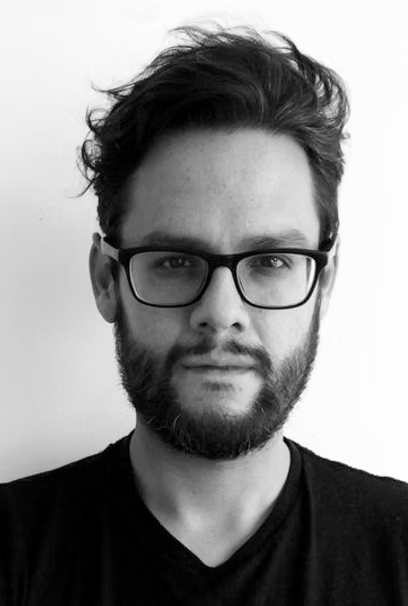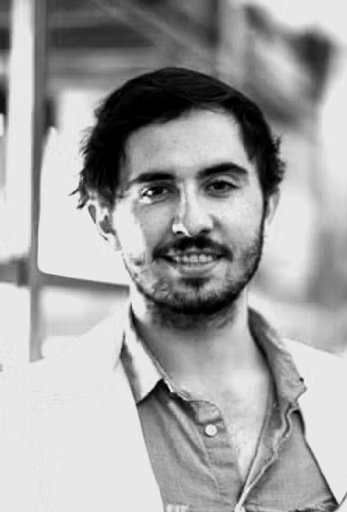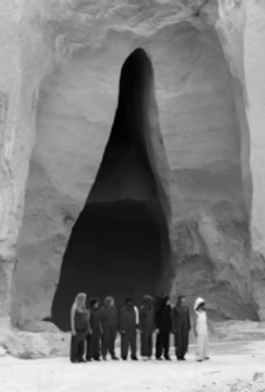

Plastic sandals washed ashore. Mangroves cleared for boutique hotels. The language of wellness co-opted to sell what it quietly destroys. For its 2019 edition, Aki Aora invited artists to work in the space between these contradictions — bringing guerrilla tactics and an Anthropocene lens to bear on the slow, invisible violence that accompanies promises of progress, growth and "eco chic" well-being, while the region's biodiversity continues to unravel.
Returning members of the Invasorix collective (MEX) — Liz Misterio, Unx and Nabil Yanai — deepened their research from the previous year, creating feminist reggaeton and facial masks as a form of social treatment: White Noise and Bring Back the Gold, the latter referencing the Spanish plundering of Mayan gold during the colonial era. Conscious of their position as outsiders, the collective directed their critique inward as much as outward.
Sebastián Terrones (MEX) presented a lecture-performance and dining experience in collaboration with Las Veracruzanas, a food stall in Tulum's central market frequented by residents and tourists alike. As the audience ate, he drew parallels between Columbus's aestheticised construction of "paradise" and the contemporary rhetoric of Tulum's tourist industry — arguing that the promise of "eco chic" represents little more than a second wave of colonialism.
Fallen Fruit (USA) extended their Endless Orchard project — Huerto Sin Fin — planting over thirty-five fruit trees in public spaces across Tulum town and Francisco Uh May, adopted and cared for by local residents. Working with children from the La Esquina Foundation, they created plastic spirit bug catchers from recycled bottles to protect the new trees, weaving together themes of recycling, community stewardship and the threat of cultural tourism.
The public programme brought together an exceptional group of speakers and performers. Ana Gabriela García (Terremoto Magazine, MEX) addressed how artistic agents can work with and subvert the colonial gaze. Alyssa Nitchun (Creative Time, USA) presented Attack of the 50 Foot Monuments. Scientist S. Beckett Gookin (USA) presented on biomimicry and the arts, tracing the ways nature's own design logic might reorient our relationship to the ecosystems we are dismantling. And at Tutti Frutti bar, Benjamin Lee Ritchie Handler (USA) took the stage as his alter ego Olivia Neutron Bomb for Trans World — a conference on the multiverse as rigorous as it was outrageous.
Beyond the residency programme, the 2019 edition opened outward into the town itself. Behind the municipality in downtown Tulum, ADN Maya brought indigenous performance to the streets, alongside Linces de Tulum, a local student band, in an electrifying evening that grounded the festival in the living culture of the region. Composer and performer Rogelio Sosa presented a live performance alongside Paradise Lost, his video art work produced during the Aki Aora 2018 residency.
The 2019 edition was curated by artist Sally Montes and London-based guest curator Sasha Galitzine.
.avif)
Wendy Cabrera Rubio and Josué Mejía explored the subject of eco-tourism, and the intersection between capitalism, entertainment, activism, protection, development, and industry in and around Tulum. The piece explores the concepts of replica, scale and model to talk about the construction of the imaginary that helps to create national identity.
The pair worked with Guadalupe a local art teacher and expert in making replicas of Mayan and historical objects. She spent a week teaching the artists how to make replica casts of pre-hispanic objects whilst telling them about her dream to create a Museum of replicas. Together the artists and Guadalupe conceptualised a gallery space instead for Guadalupe’s vision, they made a model of what it should look like and contain, playing on the concept of scales that are so important in working with replicas.
During the residency the artists looked further into the complexities of eco-tourism in the area, linking various eco-touristic architecture to the history of Mexico’s own representation of its cultural history. They focused mainly on the most prominent eco-park in the area and linked it with two architectural projects by one of the most important figures in the creation of the symbols and images of the Mexican nation the architect Pedro Ramirez Vazquez with particular reference to two of his buildings - the Mexican Pavilion in 1992 in Seville and the Museum of Anthropology in Mexico City. Wendy and Josue worked with the aesthetics of the eco-park and its billboards, in particular its use of the figure ‘X’ in relation to this letter’s prominence in mannequins of Mexico city’s important ethnographic museum and in the murals of Carlos Merida and Matiaz Goeritz (which are in the same building.) The politics of the use of the letter ‘X’ - its aesthetic in the shape of a cross as one of the weapons used to represent ‘MeXico’ rather than spelling it with the Spanish ‘j’ - emphasises Mexico’s relationship with the world and its pre-hispanic past. This letter is often present in the aesthetics of Ramirez Vazquez.
For their final work, performed in the public House of Culture in Tulum, the pair created a play in the form of a conference where the two speakers are in the form of a toucan and a macaw, represented by beautifully crafted bird-hats wings managed by the lecturers. The speakers are self-congratulatory and proud nationalists. Tucan Grande is a specialist in scale models. Red Macaw is the developer of a national building project. The characters refer to Mexico as a changing scale model dependant on various points in its national history, being enlarged or dwarfed by various external factors dependant on its significance in world history at that point, also satisfying the exoticism of Mexico when presented on a manageable small scale. The script narrates a fiction where Mexico is dwarfed to a 1:25 scale in order to appear in the Mexican pavilion of Seville in 1992 with a scale 1:70 for the projection of a gallery proposed by an artisan who is dedicated to replicate pre-Hispanic works. The development of an eco-park’s branding is explored in relationship to similar symbols of national pride to help attract more tourism. Visual progragangda of nation, park and museum as nation are all linked and presented as expressions of national pride and power, scale and the problematics of it as used to represent various indigenous identities in museology are also investigated by the characters as they continue to highlight the problematics of nation building.
"To present a country there has to be full integration between buildings and content. In order to have something that was a symbol of that crossroads of cultures, we came to the 'X', which has other connotations as well. As Mexico is the only nation that is spelt with an X (Luxembourg is a dukedom), this spelling had already been recognised by the Spaniards. On the other hand, in multiple words of Nahuatl origin, the 'X' is fundamental. Therefore we can represent that symbol."
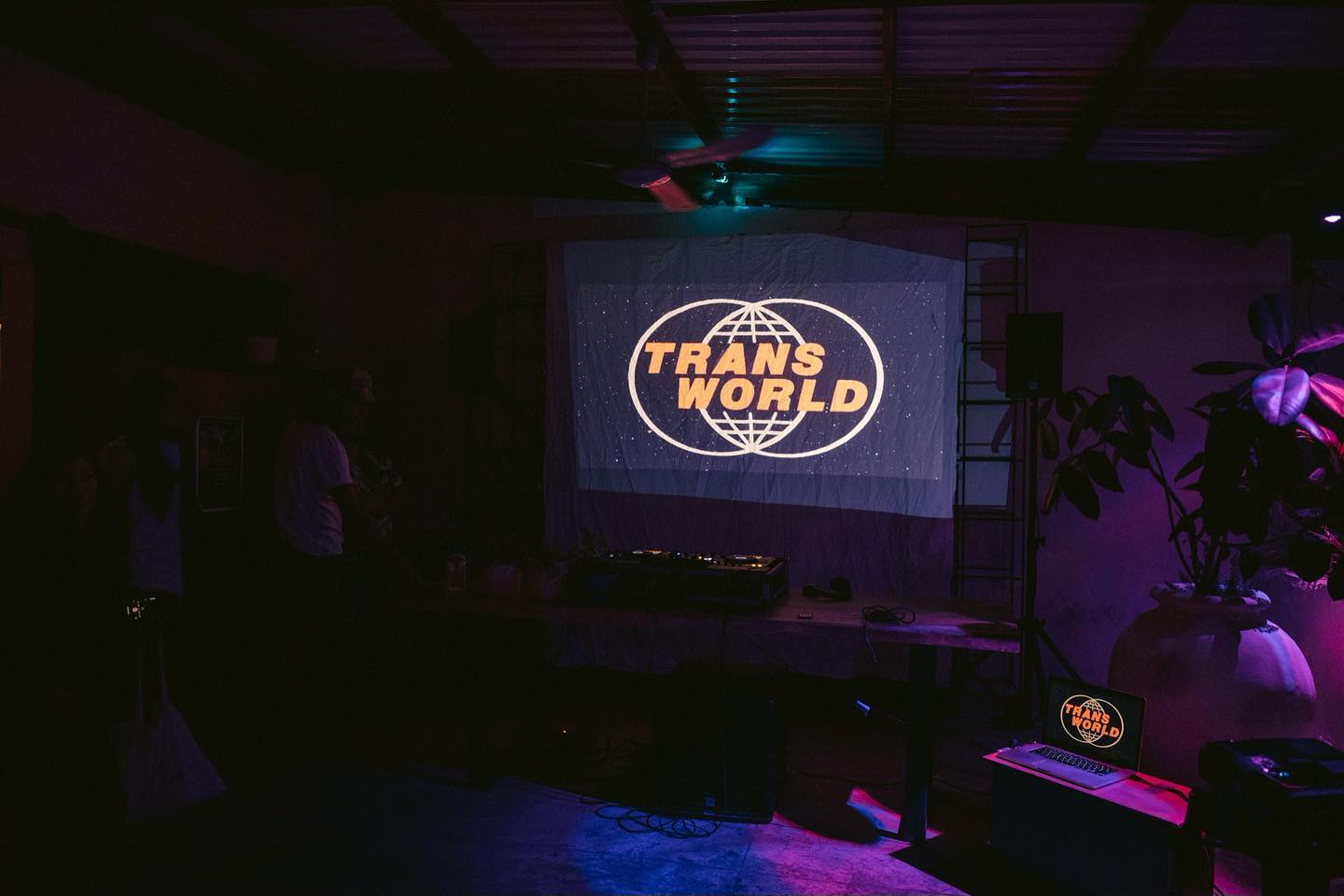
In Tulum town’s only openly queer space Fruity Bar, Benjamin Lee Richie Handler presented a new incarnation of his ‘The Olivia Neutron Bomb Variety Show’. Dressed up as alter-ego Olivia Newton Bomb - Richie Handler performed his thoroughly (in fact rather explicitly) sexual, inspirational, and musical self-help lecture on how to cope with a multi-verse of identities coalesced into a single reality.
Olivia recorded a short feature film in Tulum with various members of the residency, transferring her self-help principles to illustrate how to manifest oneself in one’s multiple identities simultaneously. ‘You too can realize, metabolize, and rationalize a multitude of yourself in the now!’ she karaoked, grooved and inspired the audience to join her on her journey.
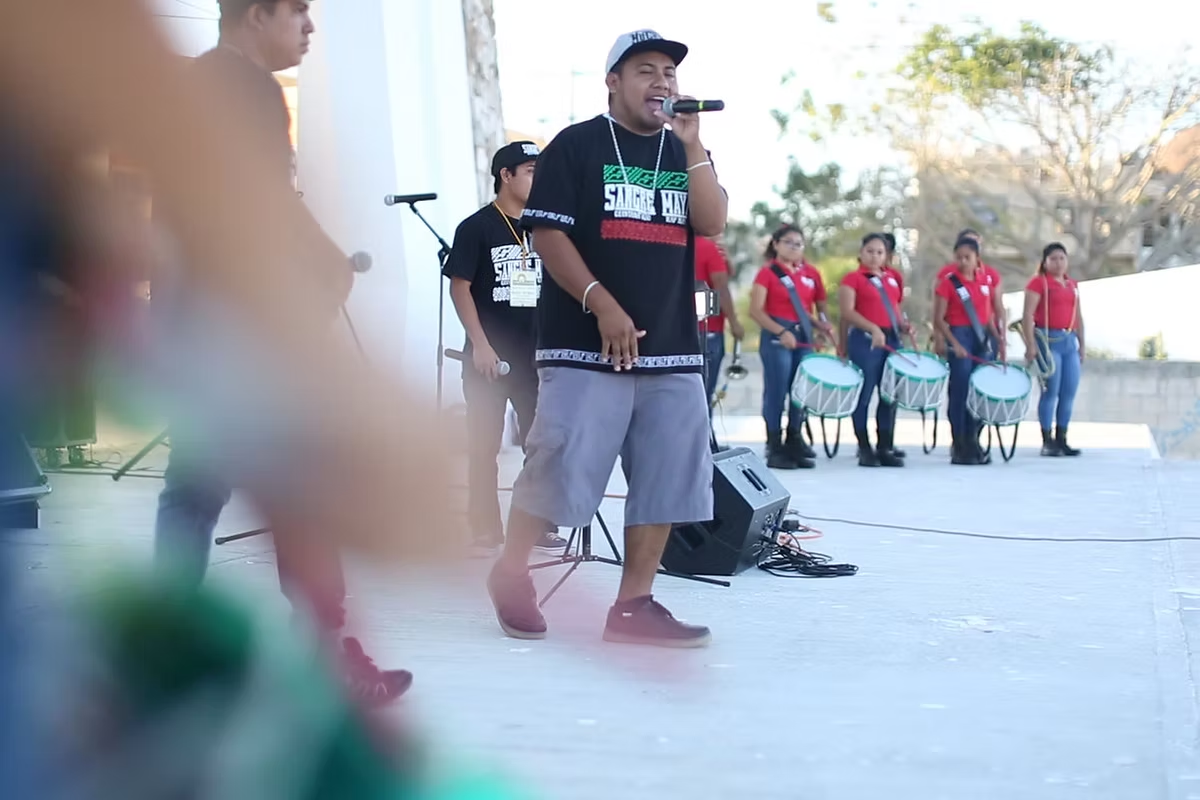
ADN MAYA & LINCES OF TULUM, broadcast live Alejandro Uh Noh for Radio Candela Mayan Radio station.
Renowned local Mayan rap band ADN MAYA did a special concert on the stage of the public Expo-feria where many of Tulum’s public concerts are staged for its residents. We invited them to collaborate with local school marching band ‘Linces of Tulum’ whom we discovered whilst they practiced on the streets of Tulum for the various competitions they are involved with.As the only school marching band with gender equality in the region we asked they and their band leader Jesus PatBoy to perform to celebrate International Women’s day. ADN Maya are one of the most important players in the preservation of the Mayan Language, a language currently severely under threat of being forgotten. We wanted to try to engage and empower members of the Mayan speaking population in the town.
In past edition of AKI AORA we have been interested in the cultural heritage of the Mayan Language. This year we invited a radio station which broadcasts in the Mayan language, it is listened to through via an app by the fishermen at sea and across the regions, bridging the gap between various communities. We asked one of their presenters Alejandro Uh Noh aka ‘The Mayan Prince’ to interview the artists and comment on the exhibitions from their perspective. Alejandro has come back every year to cover the projects live, for this edition he conducted a live broadcast of the ADN MAYA & Linces of Tulum and interviewed several of the other artists from the residency for his programme.
.avif)
S. Beckett Gookin presented his investigations into specific scientific advancement, in this case with a lecture to show how biomimicry is slowly becoming the same concept as biohacking as we begin to understand the intricacies of our own bodies and can even hack into and monitor them. He talked conceptually on how society is going to be impacted upon as a result of these changes and on what developments could stem from these discoveries. EG. To demonstrate these development he used some of his observations through biomimicry, such as a green fluorescent protein which has recently been discovered in jellyfish and which can be cloned into bacteria and then used in a lot of medical procedures and as well as in bio-art.
He then did a demonstration of how to graft different species of cactuses using cuttings and rubber bands in a participatory workshop with local children’s group La Esquina Foundation.
.avif)
In line with this year’s theme of the anthropocene and the questioning Tulum’s accelerated growth as a new form of colonialism, Rogelio Sosa was invited back to screen an edited documentation of his three-hour live performance he had developed from last year’s residency.
For the 2018 edition Rogelio was inspired by John Milton’s Paradise Lost poem and explored themes of environmental devastation as well as aspects of Mayan mythology using sound as his main medium. His research resulted in the de-construction of prehispanic instruments played live via electronic devices that he operated during the piece accompanied by four actors throughout a three-hour long play that combined ritualistic practice with synchronized actions reminiscent of the demise of the Garden of Eden - a paradise eventually destroyed. Different narrations in the Mayan language described the creation of the world and the human being, with its descent towards death and the end of time. The Mayan narrations were intertwined by another voice in English that spoke of anthropological themes including studies of colonialism, the savage man and shamanism.
‘Paraíso Perdido’ was a project curated by Sally Montes and Mascha Isserlis, released in collaboration with Una Pardo, Nabil Salazar, Alberto, Ariel from Rancho San Eric and Alejandro from Radio Candela.
This year Rogelio accompanied this screening with a live musical performance using the Mayan Tunkul as well as other pre-hispanic instruments on the stage of the public House of Culture, the audience seated in an intimate circle on stage helped conjure up the closeness of the original performance as we watched, and Rogelio talked more about the process of the performance and the themes he had been investigating.
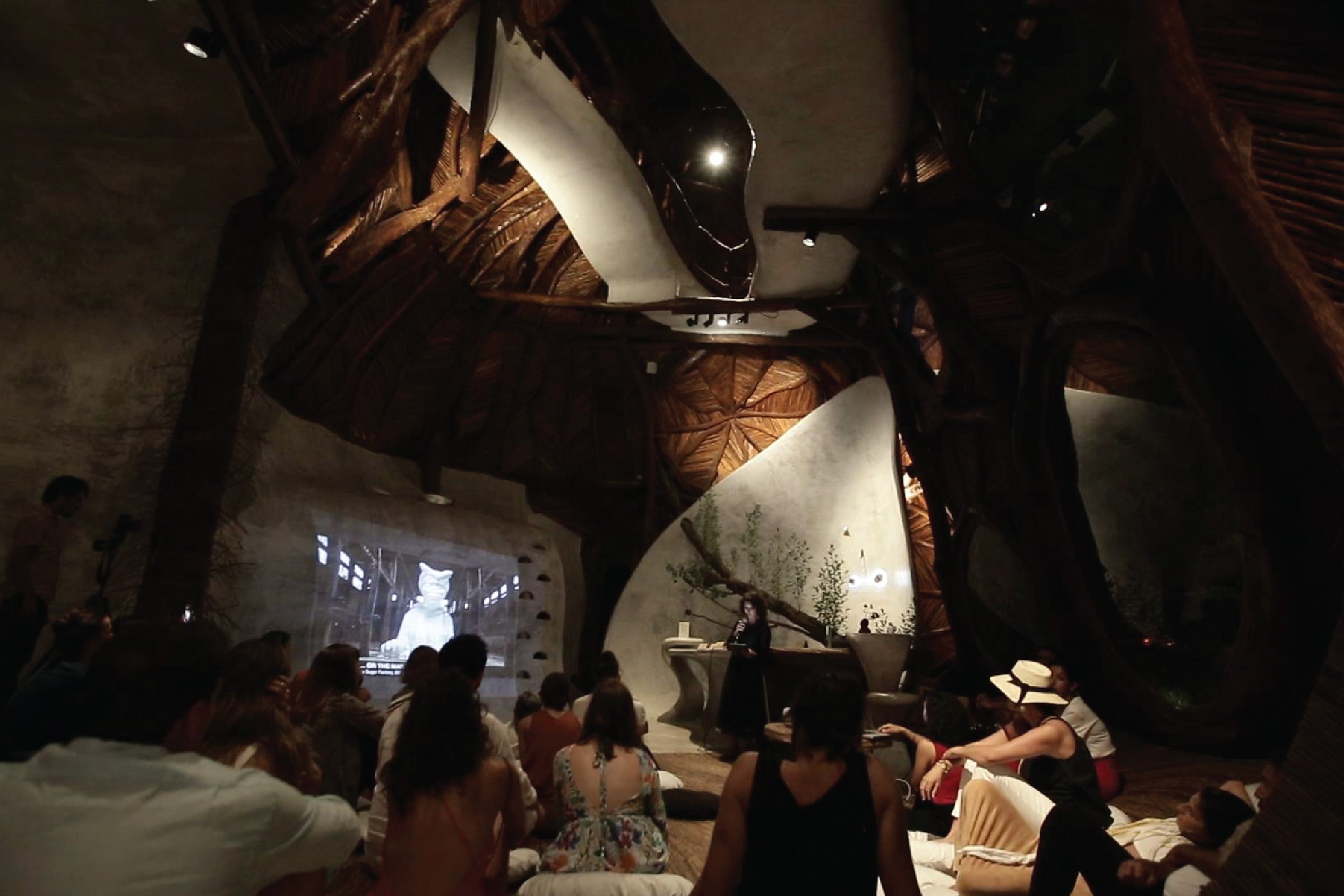
Alyssa Nitchun is an independent global art, design, and culture consultant specialising in strategic development and production. Alyssa is driven by how creativity can make our lives richer and make us better citizens of the world. From 2012 - 2018 Alyssa was with the public art organisation Creative Time in a variety of positions, most recently as Acting Executive Director, where she worked closely with the Board of Trustees to oversee the group’s many initiatives as well as short and long-term organisational growth. Prior to Creative Time, Alyssa oversaw Institutional Giving for Story Corps, the public media organisation archiving diverse oral histories at the Library of Congress. Alyssa has also been Director of Development for the CUNY Graduate Center’s Center for Lesbian and Gay Studies and has held a variety of creative positions in the worlds of art, fashion and music. Alyssa received a Masters degree in Gender Politics from NYU.
For AKI AORA Alyssa traced the evolution of socially engaged public artworks in NYC from the mid-1970s to the present considering their effects on artists, art institutions, and global communities. She also mediated a discussion between AKI AORA curators and artists with one of their local collaborators Azulik Uh May on the problematics of working in public space and engaging local communities.
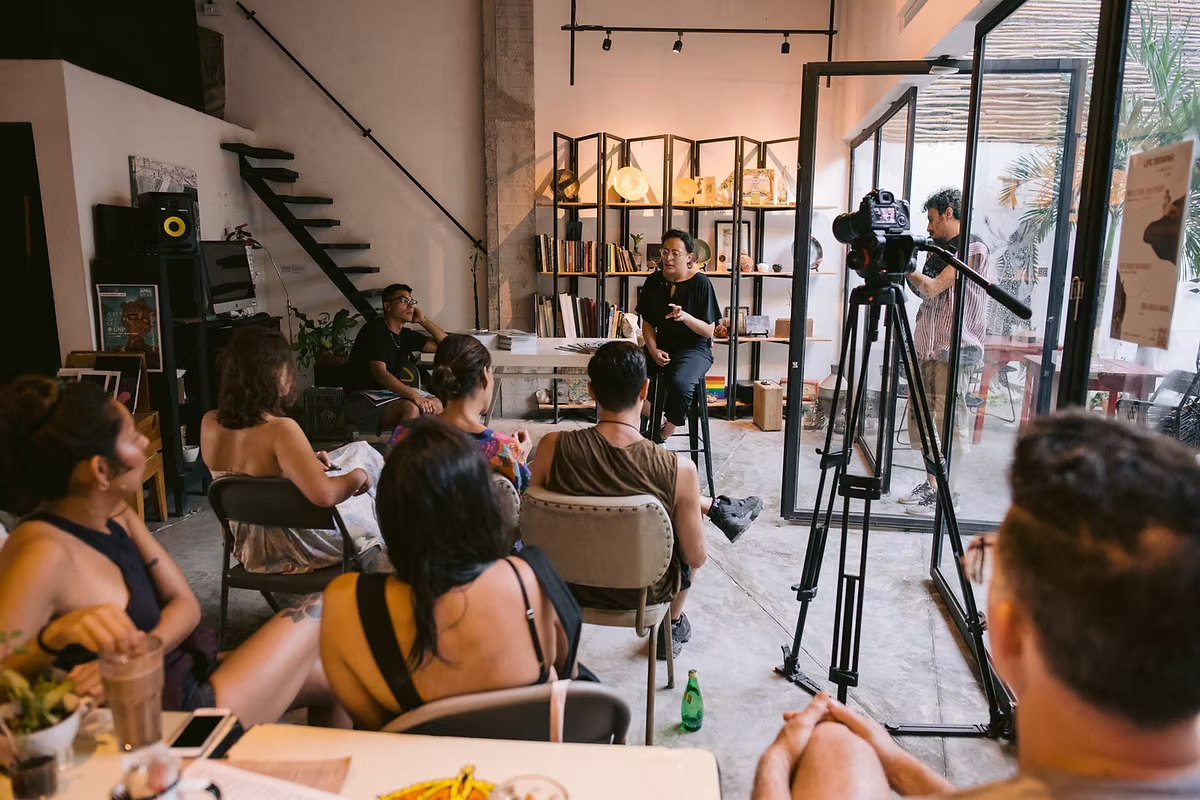
Ana Gabriela García talked about Terremoto’s most recent projects which address the question of how can we, as artistic agents, work with and subvert the colonial gaze in our practices. She introduced Terremoto’s newest issue ‘Look Who’s Talking’, as well as talking about the recently launched exhibition program La Postal, which focuses on archival investigations.
.avif)
For AKI AORA 2019 Invasorix were invited back to continue their research from last year’s residency in public space. For AKI AORA 2018 members of Invasorix (Unx and Nabil) explored, through body and dance, musical genres to "perrear" to. Having selected various reggaetón, dancehall, funky carioca, champeta, choke tracks whose lyrics uncharacteristically empowered women, they carried out different physical provocations as forms of queer feminist protest on the streets of Tulum. They used their bodies as a gesture to appropriate and reclaim public space, often positioning themselves near construction sites as a signifier to the incessant real estate construction that is part of the landscape of Tulum and that undermines the illusion, ‘eco-chic’ pretension of the place. These dances and music acted to deconstruct the exoticization and mythification of women and femininity defined on the basis of stereotypes of gender, sexuality and radicalization.
Over the past year, as an extension of this research they have been developing their own reggaeton song "My Güerx skin hurts horribly” to further probe how this musical genre can be implemented and understood as a ‘decolonial’ and feminist gesture. This led to the development of their new project for this year ‘Cop a feel on your V.I.P. position’ as they continued to explore public and private fluxes that site Tulum as a ‘caribbean paradise.’
For their first public intervention they set up a beauty studio in Tulum town’s streets - a deliberate alternative to the vernacular almost privatized beach-strip massage loungers aimed at servicing wealthy tourists. Instead they offered free facials exclusively to local Tulum residents. With their newly acquired, inconveniently long manicured nails, animal print pinnies and bright shorts as uniform they performed facial treatments which included ‘White Noise’ and ‘Give Back the Gold’ - the masks’ removal and accompanying salon conversations as symbolic cathartic acts to cleanse their clients of this ‘white noise’ probing the contradictions inherent in Tulum’s increasing take-over by the predominantly white privileged tourist.
Their project developed into working out how to rightfully and meaningfully acknowledge their own participation in this "white noise" as visiting artists, those culpable of coming to Tulum’s lands to intervene in the landscape, attempting to impose their own ways of being, living and thinking, in parallel to the tourist who arrives to the paradisiac place to consume, without caring about the social devastation and the environment that it leaves in its wake.
They developed several performative strategies to further investigate this position of privilege, firstly one in which they questioned their peers within the AKI AORA residency. Posing relevant and often uncomfortable questions to the other participants on the spot in front of a camera, questions that we as art practitioners are constantly considering; ‘What do you think of as privilege?’ as well as ‘How do you think art contributes to gentrification?’....
For their final performance, using a megaphone and dance they galvanized residents and tourists from the town’s most populated night-time area, calling any near-by observers to the space of performance, a wall near the street containing the town’s local reggaeton bar. They started their work with a bold performance of their reggaeton song who’s content reinforced and further probed questions of ‘white privilege’ and mocked and advised the guerra or ‘pale one’ on being more aware and demands that they face their ‘TASTY PRIVILEGES!’....WE TWERK THE WHITE SUPREMACIST CAPITALIST PATRIARCHY TO SMASH ITS COLONIALISM AND MONOPOLY.’
A video compilation of the interviews by residents and themselves on these notions then followed, focusing on the varying positions of the Mexican, US and British members of the residency, a ‘commercial break’ then ensued with a short advert containing the different facial masks they’d invented before culminating in a text-based intervention on the wall in Spanish and Mayan… a lasting public intervention for Spanish and Mayan speaking audiences along these themes of privilege.
.avif)
“And when I arrived to this cape, the smell of flowers or trees of the earth was so good and sweet , I can asure it was the sweetest thing in the world. […]
A beautiful land full of different trees in a thousand ways and endless palms. […]
And after dawn many of these men came to the beach, all young men, all of good stature, and very beautiful [...] They must be good servers […]
Because I believe that there is the Paradise on Earth, where nobody can reach, except by divine will [...]"
- Christopher Columbus
Sebastian Terrones (b. Cancun) used his recent research on the Anthropocene as a starting point for his new project “From Earthly Paradise to #Paradise”, comparing the colonial past to today’s Tulum as a case study of the axis of power that structures this New Age of Man. Focusing specifically on the historical use of aesthetics as a colonial tool, he analysed the paradisial imaginary devised and exploited by Christopher Columbus and other colonial actors in relation to their experiences in the Caribbean and the repercussions that these encounters have had on the modern perception of Nature and humanity, relating them to the contemporary aesthetics of the destructive boom of the tourism industry and Tulum’s new wave of ‘eco-chic’ tourism.
The history and scars of colonialism, as well as the coloniality of power caused by them, are still very much present in the local area, Sebastian’s project for AKI AORA manifested in the form of a lecture-performance cum dining experience, a collaboration between the local market food stall “Las Veracruzanas” in the town’s central market that predominantly residents but also tourists frequent. He conceived a delicious four course meal ironically named “Paradise Delights”, based on the structure of a mexican “comidas corridas”, a kind of healthy traditional fast food meal, accessible for all people, with a menu full of witty nods to contemporary and historical colonialism in the descriptions of the ingredients, with course titles such as “Bittersweet Encounter Soup” and “White Industry”, to be consumed by those in the market whilst listening to his accompanying lecture.
As we ate he linked Columbus on one side, to contemporary Tulum on the other, drawing parallels with Tulum tourist industry’s paraphernalia and the use of words like ‘eco-chic’ to attract tourists with Columbus’ cultivated concept of ‘paradise’ - his aesthetic constructions strategically devised to sell the idea of colonising the Americans back to the Spaniards. Drawing our attention to Tulum tourist slogans and aesthetics to be as questioned and deconstructed as Columbus’ imagery, Tulum suggestive of an almost second wave of colonialism, with a very similar fetishisation of paradise, that is again accompanied with the same promise of boosting the economy and of ‘progress’ that the “Conquistadores” suggested.
“What is Tourism and its contemporary paradises, other than a exponential perpetuation, both in form and in operation, of the same colonial white task started more than 500 years ago?
An extractive monoculture that turns everything that it touches into empty static images, unlinked from the territories and local organic cultures, intended only to satisfy the sensory pleasure and visibility of a few.”
Some of the locals followed the call for free food and then realized it was also a performance on these themes. As Terrones developed his lecture he wrapped the accouterments of tourism over his body, objects that had a direct relationship between this contemporary industry and Columbus’ diaries’ appointments, hammocks, t-shirts with full breasted women emblazoned on them, a large woven structure similar to built structures used in the fabrics of these instagram / eco-chic aesthetics, until he was fully concealed, weighed down and made anonymous and unable to continue the storytelling by these culturally appropriated and populist garb.
Vegetable and ammunition soup, served in a red blood broth of tomato, beet and turmeric, accompanied by three white caravels of hard boiled egg and a touch of sugar cane.
A tropicalization of the traditional dish "Moors with Christians", composed of a tasteless white rice, stirred and embroiled by a frenzy of various, inflamed flavors of chaya, a mixture of different vegetables and a touch of habanero pepper in constant rebellion.
A immaculate monolith of panela cheese, cemented over an abundant puddle of privileges of petroleum black mole, with tonal accents of constant exploitation, racism and environmental degradation.
More of the same thing. White bread without crust, supported by a constant stain of blood red jam.
A taste of sweet utopia, elaborated from the collective effort of multiple living beings and stories of long-term resistance.
.avif)
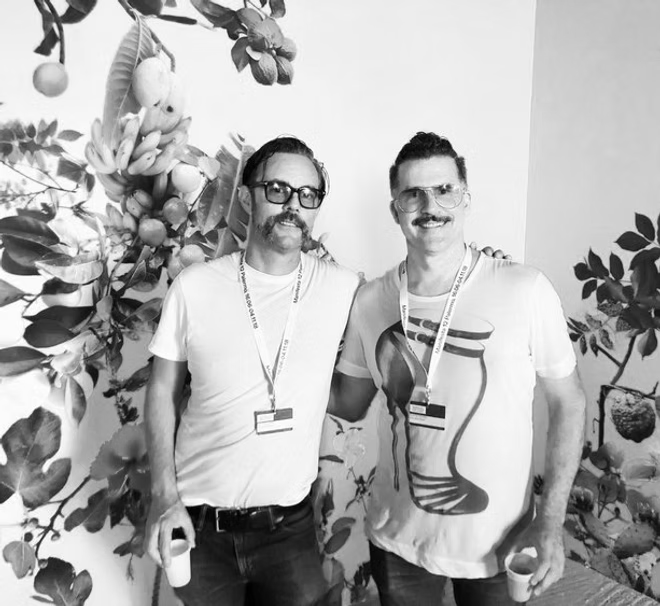
Fallen Fruit’s first initiative was to map all the fruit trees growing within the public right of way land in a neighborhood of Los Angeles. Over the years, the collaboration has grown to include serialized public art projects, site-specific installations and public happenings in cities throughout the world. Working with photography, video, recontextualized objects, cartography, and wallpaper patterns, the artists use fruit and/or public spaces as a material or artistic means; their practice aspires to invoke new systems of understanding the ways we interact with public space and the natural world, especially in developed urban areas, such as how culture impacts a place and becomes “everyday life.” David and Austin’s projects invite people to experience their city as a fruitful, generous place, to collectively re-imagine the nuances of public participation and urban space, to ponder forms of located citizenship, and to explore the meaning of community and neighborhood through creating and sharing available resources.
For AKI AORA 2019, Fallen Fruit continued their exploration for the meaning of place and community with support from Azulik Uh May, Fallen Fruit extended their ‘Endless Orchard’ or ‘Huerto Sin Fin;’ fruit trees that are planted in the public right of way, to be shared by everyone and connecting neighborhoods across communities. The artists did their research focusing on and the area called Tulum town and the village of Francisco Uh May. They met with local residents, business owners, and community leaders to learn about local histories and cultural rituals. The artists went door to door inviting neighbors to participate in the project by adopting and caring for fruit trees to share with their community. Over thirty five fruit trees were planted in public spaces and adopted by local residents in a constellation linking Tulum town with Francisco Uh May. The Mayan language, which is under threat of extinction, was a vital component in the accessibility of the project, with a strong Mayan community still present in the region. A hand crafted wood sign placed at each fruit tree explains how to share the tree’s resources and care for it - both in Spanish and Mayan.
The artist’s created a hand drawn map of all existing fruit trees in the area including the newly planted fruit trees to activate this shared resource for the community. The artists appropriated a long standing strategy of local business in the area and hired a local work truck to drive around the area with a recorded message publicizing the project from a megaphone on top of the car. This driving procession as public intervention invited local community members and business owners of Tulum town and Francisco Uh May to share their fruits. The message was recorded in Spanish and Mayan. Everyone was encouraged to plant the trees and participants signed adoption forms agreeing to help care for the trees and share the fruit when ripe. The artists conducted a workshop with a local after school program called La Esquina Foundation. The youth created plastic spirit bug catchers from recycled plastic bottles to protect the trees and prevent potential diseases for the new fruit trees, teaching the children about recycling and safeguarding the fruitful trees.
As part of the fruit planting and research process, David and Austin with a support team from AKI AORA and IK LAB created a new film work, HUERTO SIN FIN which tells the story of this collaboration and focuses on the alarmingly present advent of cultural tourism in the area threatening this natural paradise, the currency used to attract tourists in the first place.
Fallen Fruit is an art collaboration originally conceived in 2004 by David Burns, Matias Viegener and Austin Young. Since 2013, David Burns and Austin Young have continued the collaborative work.
Handmade signs written in Spanish and Maya are instructions for when to harvest and how to care for each tree:
A public participatory project for everyone to share.
This fruit tree is a part of the Endless Orchard.
The fruit is for everyone, including you.
When ripe, please taste the fruit and share it with others.
Take only what you need.Say “hi” to strangers.
Take a friend.Go by foot.
This is a orange tree.
Oranges are ripe in May.
FRUTA PARA TODOS is a call to action and a poem.
This message was recorded for the fruit truck recorded in both Mayan and Spanish.
FRUTA PARA TODOS!
Naranjas!
Limones!
Mandarinas!
Papayas!
Guanabanas!
MANGOS! Aguacates! SAPOTESCOMPARTA FRUTA
CON SUS VECINOS.CON SU COMUNIDAD
CON LOS SUYOS
CON LOS OTROS
CON LAS OTRAS
HAGAMOS UN HUERTO INFINITO!
UNAMONOS
UNETEAQUI AHORA
FRUTA PARA TODOS!
FRUTA PARA LOS SUYOS
FRUTA PARA OTROS
FRUTA PARA OTRAS
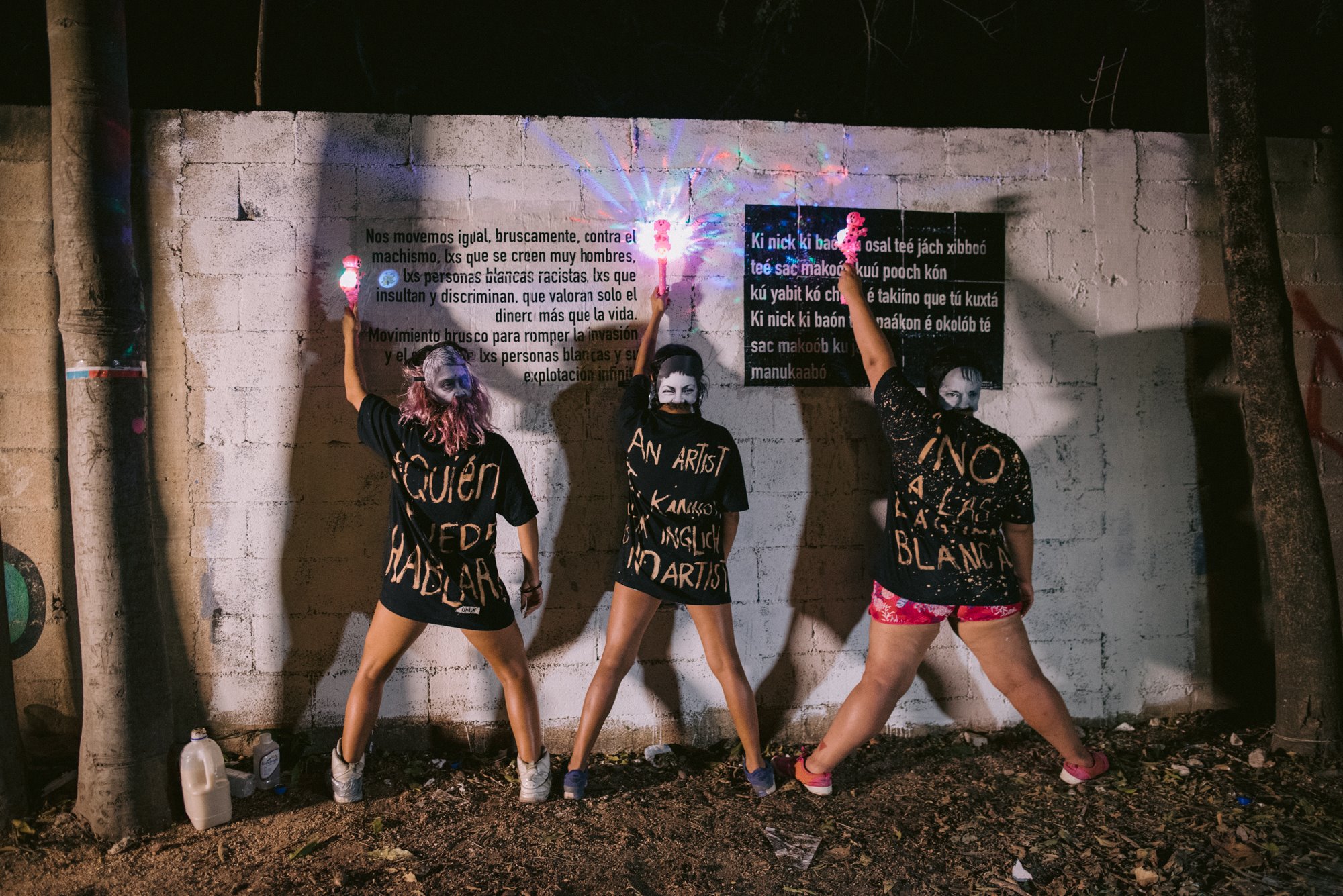
Returning members of the Invasorix collective (MEX) — Liz Misterio, Unx and Nabil Yanai — deepened their research from the previous year, creating feminist reggaeton and facial masks as a form of social treatment: White Noise and Bring Back the Gold, the latter referencing the Spanish plundering of Mayan gold during the colonial era. Conscious of their position as outsiders, the collective directed their critique inward as much as outward.