
In 2018, Tulum was ecologically singular, culturally layered, and alive with the kind of contradictions that make for urgent and compelling art. For its second edition, AKI AORA continued to ask how site-specific research-based practice might respond to the social and environmental realities of the territory in real time. The residency has operated as a laboratory: artists are invited not to present existing work but to allow new practice to emerge from sustained engagement with the place, its histories and its contradictions. The result was an edition that refused easy positions, holding utopia and dystopia in tension as two faces of the same reality.
Months before the residency opened, Kaitlyn Aurelia Smith performed in a kickoff event that set the tone for the edition — her layered, organic electronic compositions a kind of overture to the questions that would follow.
The residency brought together artists whose practices, though distinct, were united by a shared attentiveness to systems — ecological, political, cultural, sonic — and to the ways in which those systems break down, mutate and persist. Hendrik Weber, known as Pantha du Prince, developed The Orchestra of Forgotten Skills in collaboration with the children of La Esquina Foundation, guiding them to build their own instruments from scratch before performing together alongside Weber and his bells — a fleeting, unrepeatable ensemble conjured entirely from the encounter between artist, community and place.
Interspecifics (Leslie Garcia, Paloma López, MEX) developed Species Resiliens through an immersive investigation into the intersections of biology, sound and machine intelligence — probing the communicative and adaptive capacities of living systems, and asking what forms of intelligence, relation and coexistence remain illegible to the human sensorium.
Mario García Torres (MEX) traced a somewhat esoteric cultural history of rivers in Five Feet High and Rising — a work that charted and merged different stories of movement, migration and fragmentation, drifting through a combination of images and music that made reference to small and large waterways alike. In a personal narrative that disrupted and traversed chronological time, García Torres directed the overflows of these disparate rivers together into a performed new narrative, finding in the flow of water a metaphor for the flows — of people, capital, culture — that define Tulum today and beyond.
Invasorix (MEX) developed Perreadoras Aguafiestas on site — their feminist reggaeton and collective performance practice a refusal of the sanitised, aspirational image of the region, insisting on the bodies, voices and politics that that image works hardest to erase.
Wendy Cabrera Rubio and Josué Mejía (MEX) turned their research towards Xcaret and the mechanics of cultural spectacle, collaborating with Guadalupe, a local art teacher and expert in pre-Hispanic replicas, to develop Apocalipto: El Estilo Maya Aplicado a las Artes Auxiliares. Presented at the Casa de la Cultura in Tulum, the work applied Mayan aesthetics to the auxiliary arts with sharp irreverence — a layered commentary on cultural appropriation, the spectacularisation of indigenous heritage and the tourism industry's appetite for a pre-packaged past.
Ahmet Öğüt (TUR) developed The Missing T — a single channel video work that emerged from his close observation of the social and political life of Tulum's community: the abandoned sign bearing the town's name, and the recently fired policemen who had protested for forty-five days demanding basic rights — officers required to purchase their own uniforms, equipment, healthcare and even accommodation during training. A work about what a place costs those who are made invisible by its reinvention.
Taus Makhacheva (RUS) developed And Then, Mexico Happened in collaboration with chef José Luis Hinostroza但 — a dessert inspired by the porous limestone rock of the Yucatan region, crafted to look like rocks but made of soft meringue filled with huitlacoche, shared with the audience during her presentation. A work that dissolved the boundaries between art, territory, taste and encounter.
Rogelio Sosa (MEX) developed Paradise Lost during his residency — a performance drawing on John Milton's epic poem as a departure point, performed live alongside local actors from Tulum's service industry.
The public programme extended the residency's questions into open dialogue. Paul Miller aka DJ Spooky spoke about his recent research in Antarctica, exploring sound, ice and the aesthetics of climate emergency. Mariana David reflected on her curatorial practice. And curator Nika Chilewich shared her curatorial practice in Mexico City
The 2018 edition was curated by Sally Montes and Masha Isserlis.
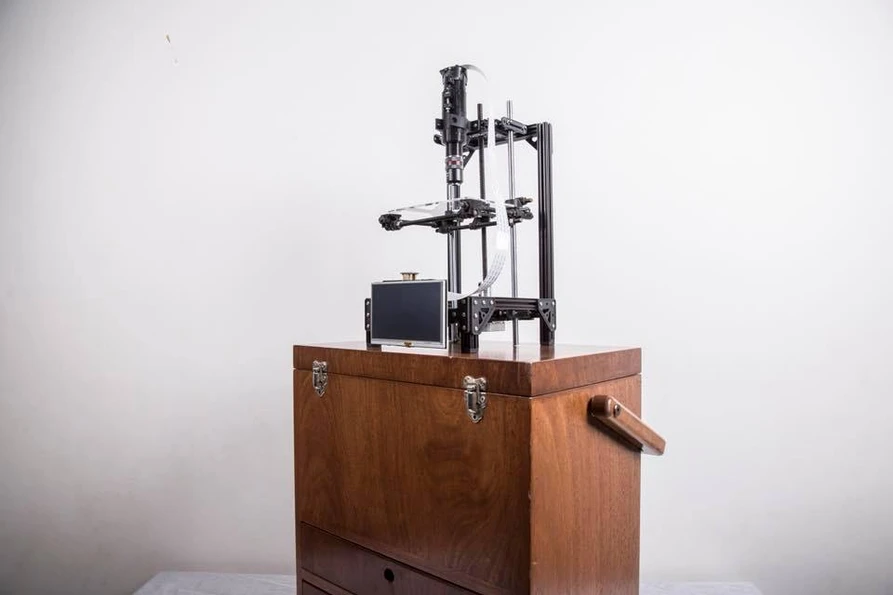
In the first two weeks of February 2018 we began an artistic exploration in Tulum, Mexico during which we found a radical marine pollution in ltrating in the landscape: contemporary symbiotic relationships in which different forms of life inevitably were coexisting with plastic and other human waste.
With the use of a self-built microscope we took on the task of monitoring on a small scale the forms that these new symbiosis were throwing at us in order to express the poetics of resilience. In the microscopic domain, all forms remind us that life is a platform for abundant materiality, that the non-organic is also a natural physical arrangement; and that the ocean shapes our plastics in the same way as the rest of material waste giving genesis to hybrid species. This con rmed to us that nature always wins. In this live performance we use the microscope as a living sound interface, the poetics of resilience expressed in sound and sound as a bridge connecting species.
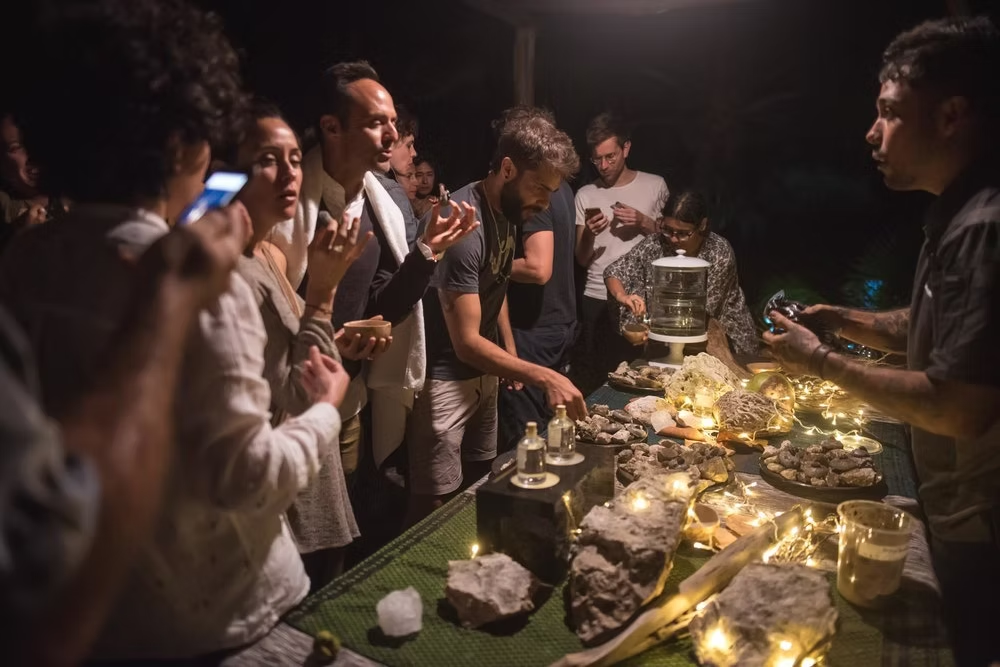
Here and now, you arrive to Tulum to be curious, to touch things, to be touched by things. You are standing on calcareous rock, the colours are overwhelming, especially if you come from a low saturated part of the world. You become grounded and present, like a rock you are standing on.
There are rocks that make you heavier, there are rocks that make you lighter. The rocks you swallow here turn into a porous strainer inside your belly and sift things through.
It is a place full of stories and its often hard to understand who is telling the story: the invaded, the invaders, the rebels or others, unnamed yet. Huitlacoche or fungus or corn smut or Mexican truffle - one ingredient and too many names. Yesterday’s Aztec daily food. Today’s delicacy in one geography and pest in another.
Corn as a time travelling ship that evolved from domestication of jungle and through many species and timelines.
There is liquid in your mouth, a juice that came from pressing a rock with your tongue. Rock made from fungus, fungus that grows with corn, corn that all people are made from.
(1) From french amuse-bouche
(2) According to Popol Vuh: the Sacred Text of the Ancient Quiché Maya
Ahmet Ögüt has been observing facts about Tulum that appears at first in surreal manner, as writer Sezgin Boynik refers “social surrealism” when talking about Ögüt’s artistic practice.
Things which can be observed from the daily social-political life of the community, like the abandoned sign of the name of the town or recently fired policemen after they protested for forty five days to gain basic rights for their own safety. As they need to buy even their own uniforms and equipment, pay their own healthcare and even pay for their own accommodation during the trainings.
Ögüt coded his film using Mayan traditions and language like the Obsidian black stone, which was used by the Mayans to watch the sun eclipses.
The stories in his film are unified around the original letter T which was missing and uses it as a red thread which connects the narrative and creates a poetic twist to the video work.
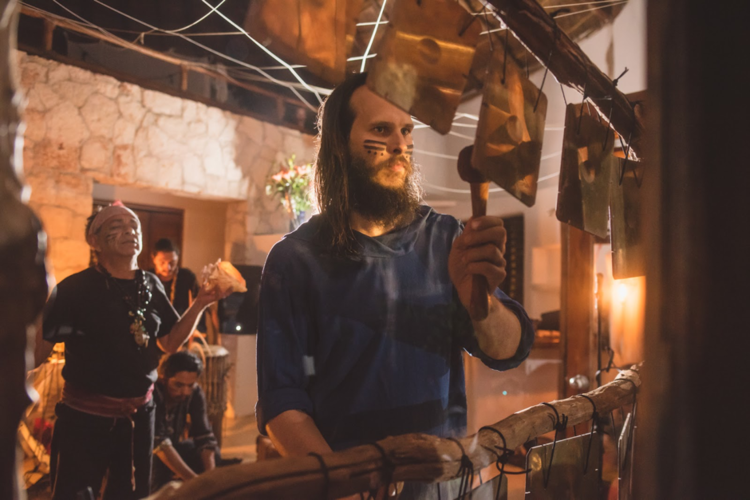
Hendrik Weber aka Pantha du Prince made a research during his residency time and established various collaborative processes which resulted in a row of workshops and performances taking place during the residency and the public program in Tulum, Mexico. Redeveloping his living space into a music studio and working on a long term project The Conference of the Trees during his research Hendrik was initially interested in the different kinds of wood which are used for the Mayan instruments. With maestro Jose, a wisdom keeper of the Mayan rituals and a specialist of the prehispanic music instruments Hendrik worked on the wood block percussion, Tun Kul which he carved under the supervision of the maestro. Together with the Tulum based organisation La Esquina, who works with the local children from Tulum, Weber and Maestro Jose organised a special workshop, where children were given lessons in producing and playing different percussion instruments. For the AKI AORA Public Program 2018 Hendrik developed an installation and a special performance Orchestra of forgotten Skills. The choreography of the sounds was initially inspired by the colors used by Mayans to define the four directions of the world: the red for the East, the black for the West, the yellow for the South and the white for the North, which represents the Sun Circle with the blue color in the middle, which is the fusion of all the directions. The music narration was composed out of eight parts: basic tone, transition, water, air, earth, fire, epilog and final. The basic tone was performed by Hendrik Weber on the Russian singing bells, in the transition he was joint by all the musicians and followed by a call of the spirits of the four directions by Maestro Jose. For the four elements the musicians had a different individual rhythm for each as an ensemble together, which created the foundation for the intuitive musical interaction. In the epilog maestro Jose was explaining the meaning of the relations between the Mayan mathematics, the star constellations and why all the participating musicians were marked with a certain magic number 13, which was a group unifying symbol and added to another magic number 52. In the final all the elements meet, increase intensity and dissolve into a transcendent space for everyone in the room. Through performing the Orchestra of Forgotten Skills by embodying each element in forms of rhythm and sound we return again to the basic human existential questions of meaning and relation.

Paul D. Miller a.k.a. DJ Spooky gave a lecture and performance for the opening of AKI AORA 2018 where he presented some of his his own multimedia, multidisciplinary study of Antarctica
.avif)
In Five Feet High and Rising, artist Mario García Torres tracks a somewhat esoteric cultural history of rivers. Five Feet charts and merges different stories of movement, migration, and fragmentation while drifting through a combination of images and music that make reference to small and large waterways. In a personal story that disrupts and traverses chronological time, García Torres directs the overflows of these disparate rivers together into a performed new narrative.
.avif)
Inspired by John Milton´s Paradise lost poem, Rogelio´s work during AKI AORA focused on exploring themes of devastation of the environment and Mayan mythology using sound as the main medium. The research resulted in the deconstruction of prehispanic instruments played live via electronic devices that the artist operated during the piece accompanied by four actors throughout a two hour long play that combined ritualistic practice with synchronized actions that were meant to remind the audience of the demise of eden - alluding to a paradise that is eventually destroyed. Different narrations in Mayan language described the creation of the world and human being, with its descent towards death and the end of times. The Mayan narrations were intertwined by another voice in English that spoke of anthropological themes that study colonialism, savage man and shamanism.
Paraíso perdido is a project curated by Sally Montes and Mascha Isserlis, released in collaboration with Una Pardo, Nabil Salazar, Alberto?,Ariel? From Rancho San Eric and Alejandro from Radio Candela.
.avif)
Mariana David has been coordinator of the alternative art space La Panadería, director of MUCA Roma, UNAM, where she developed the Program The Right to the City, and as a freelance curator, launched an artist residency at the Northern border town of Cd. Juárez.
She participated in the recently published Art and the Global Economy (University of California Press) edited by John Zarobell, She currently works on a documentary on the relationship between journalism, politics and spectacle in Mexico, and is coordinator of the Education Program at Museo Tamayo.
.avif)
Nika Chilewich was invited as a speaker to give a talk and presentation on her recent curatorial projects 'trapos sucios' and museo Sierra Hermosa.
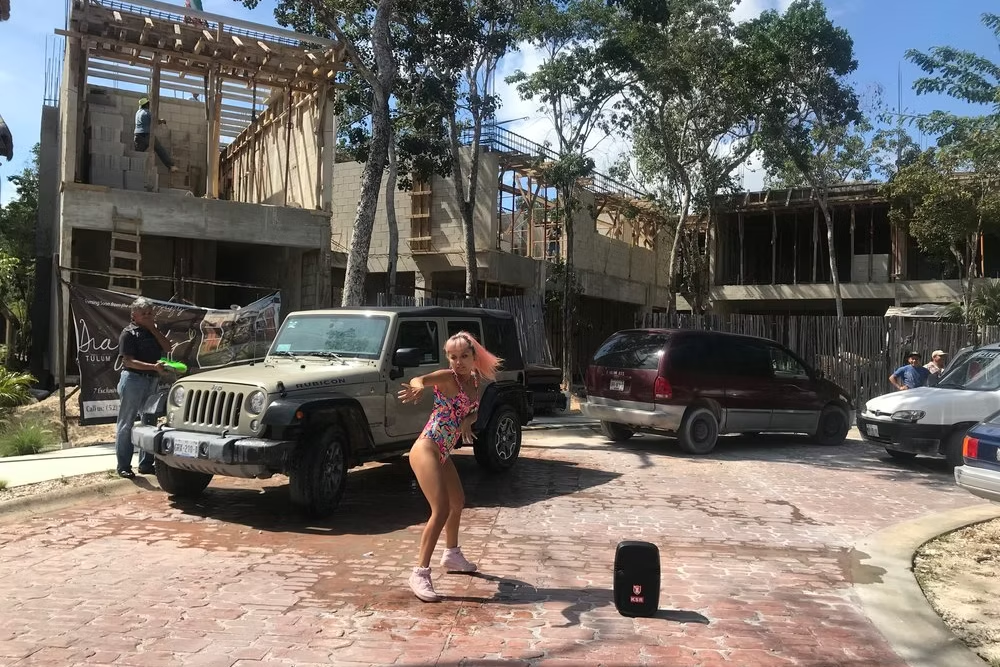
During the AKI AORA residence program (Tulum, 2018) we explored through body and dance musical genres to "perrear," such as: reguetón, dancehall, funky carioca, champeta, choke, etc. which led to PERREADORXS AGUAFIESTAS, in which we carried out different physical provocations as forms of cuir-feminist protest.
One of these provocations consisted of touring Tulum accompanied by a portable speaker invading the public space with "periciosras music" and our unique dance. Understanding the latter as a joyful body practice, self-fulfilling that allowed us self-recognition and self-representation to appropriate songs identified from a class perspective, to be misogynist and sexist. With this, to twist from our bodies the exoticization and mythification of women and femininity defined on the basis of stereotypes of gender, sexuality and racialization, as an extension of certain territories such as the Tropics, the Caribbean, and Latin America. The enunciation that we are not an articulation of the landscape available to be consumed.
We invaded the peripheral streets of Tulum, the constructions in black work and garbage dumps. Secluded places, without any tourist interest, that on the one hand dislocate the paradisiacal / eco-chic / luxurious idea of Tulum and on the other are places that in a generalized way are identified as spaces for physical and symbolic harassment and violence for the feminized bodies. Therefore, they are also propitious spaces for sabotage; to "misbehave", move the ass as we want, where we want, to put the body without fear, to make it our street, even if transitorily.
Simultaneously to these provocations, we made a musical album also called PERREADORXS AGUAFIESTAS that compiles 28 songs of "musicas pa 'saCUIR los asses and genres" made by women between the eighties and 2017, where different perreo musical genres meet, constituting a file that accounts for and places the celebration and production of other feminities, and highlights the false stability of any type of gender. For the dissemination of this compilation, we went back to the streets by means of a street broadcast through a mircophone and speaker, in which at full volume we presented our imagined friends, we danced their songs and we shared the project with the different women that we met in the tours, Specifying small meetings in which we told the women of who we listened to, why we danced and why this was a form of protest trying in that exchange possible complicities. PERREADORXS AGUAFIESTAS allowed us to disturb the public space with our joyful presence, let's go for more!






.avif)