.avif)
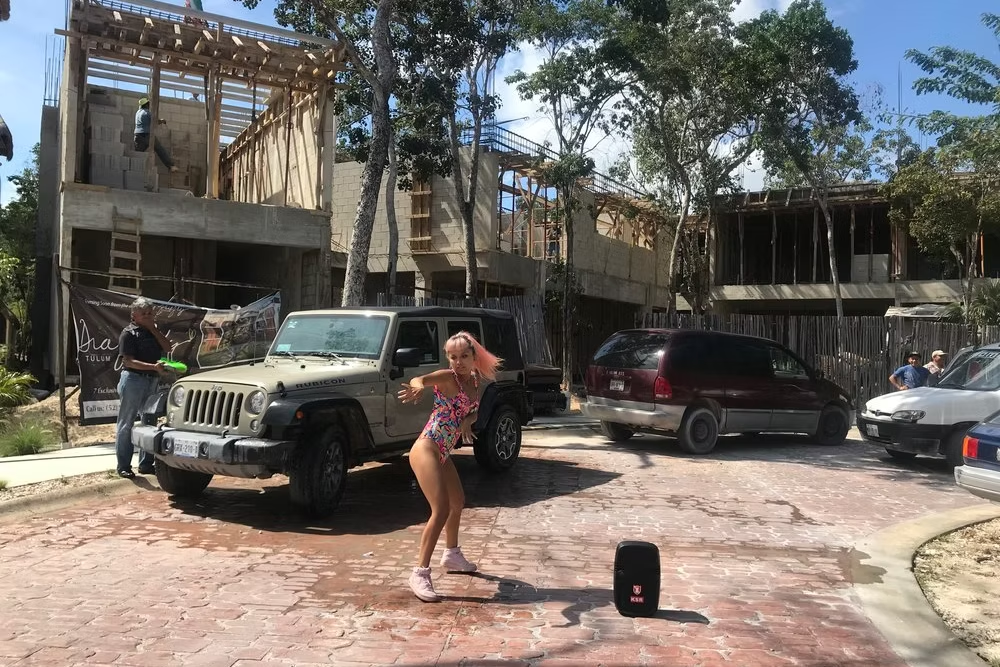
Wendy Cabrera Rubio and Josué Mejía explored the subject of eco-tourism, and the intersection between capitalism, entertainment, activism, protection, development, and industry in and around Tulum. The piece explores the concepts of replica, scale and model to talk about the construction of the imaginary that helps to create national identity.
The pair worked with Guadalupe a local art teacher and expert in making replicas of Mayan and historical objects. She spent a week teaching the artists how to make replica casts of pre-hispanic objects whilst telling them about her dream to create a Museum of replicas. Together the artists and Guadalupe conceptualised a gallery space instead for Guadalupe’s vision, they made a model of what it should look like and contain, playing on the concept of scales that are so important in working with replicas.
During the residency the artists looked further into the complexities of eco-tourism in the area, linking various eco-touristic architecture to the history of Mexico’s own representation of its cultural history. They focused mainly on the most prominent eco-park in the area and linked it with two architectural projects by one of the most important figures in the creation of the symbols and images of the Mexican nation the architect Pedro Ramirez Vazquez with particular reference to two of his buildings - the Mexican Pavilion in 1992 in Seville and the Museum of Anthropology in Mexico City. Wendy and Josue worked with the aesthetics of the eco-park and its billboards, in particular its use of the figure ‘X’ in relation to this letter’s prominence in mannequins of Mexico city’s important ethnographic museum and in the murals of Carlos Merida and Matiaz Goeritz (which are in the same building.) The politics of the use of the letter ‘X’ - its aesthetic in the shape of a cross as one of the weapons used to represent ‘MeXico’ rather than spelling it with the Spanish ‘j’ - emphasises Mexico’s relationship with the world and its pre-hispanic past. This letter is often present in the aesthetics of Ramirez Vazquez.
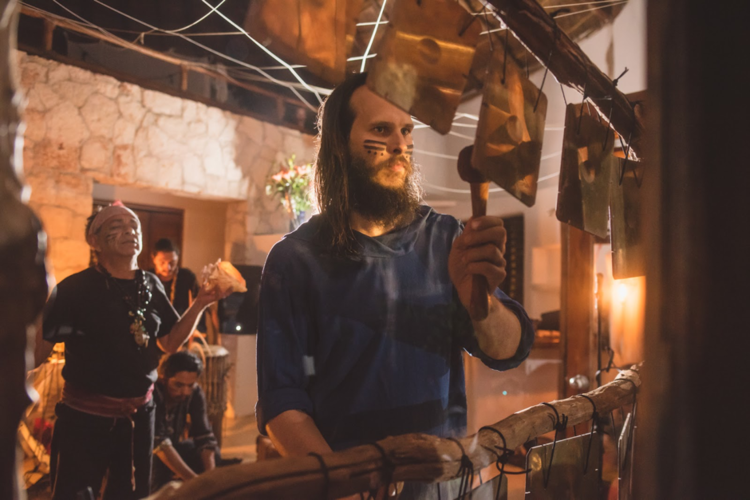
For their final work, performed in the public House of Culture in Tulum, the pair created a play in the form of a conference where the two speakers are in the form of a toucan and a macaw, represented by beautifully crafted bird-hats wings managed by the lecturers. The speakers are self-congratulatory and proud nationalists. Tucan Grande is a specialist in scale models. Red Macaw is the developer of a national building project. The characters refer to Mexico as a changing scale model dependant on various points in its national history, being enlarged or dwarfed by various external factors dependant on its significance in world history at that point, also satisfying the exoticism of Mexico when presented on a manageable small scale. The script narrates a fiction where Mexico is dwarfed to a 1:25 scale in order to appear in the Mexican pavilion of Seville in 1992 with a scale 1:70 for the projection of a gallery proposed by an artisan who is dedicated to replicate pre-Hispanic works. The development of an eco-park’s branding is explored in relationship to similar symbols of national pride to help attract more tourism. Visual progragangda of nation, park and museum as nation are all linked and presented as expressions of national pride and power, scale and the problematics of it as used to represent various indigenous identities in museology are also investigated by the characters as they continue to highlight the problematics of nation building.
"To present a country there has to be full integration between buildings and content. In order to have something that was a symbol of that crossroads of cultures, we came to the 'X', which has other connotations as well. As Mexico is the only nation that is spelt with an X (Luxembourg is a dukedom), this spelling had already been recognised by the Spaniards. On the other hand, in multiple words of Nahuatl origin, the 'X' is fundamental. Therefore we can represent that symbol."
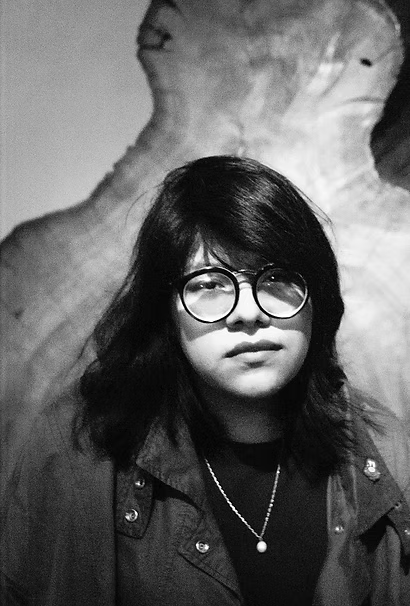
Works mainly with the discursivity of the scientific stories, as well as its consequences in the economy, industry and aesthetics. She has a particular interest in research, insertion in specific communities and collaboration with third parties. Her projects are developed in different media such as installation, video and didactic theater.
She completed her undergraduate studies at the ENPEG "La Esmeralda" and later entered the SOMA Educational Program. Her work has been presented at the MUCA, Karen Huber Gallery, Lodos, Anonymus, Biquini Wax EPS, Ex-Teresa Arte Actual and the National College.
Wendy is a member of LADRÓN galería, an independent platform for the production, discussion and exhibition of contemporary art in Mexico City.
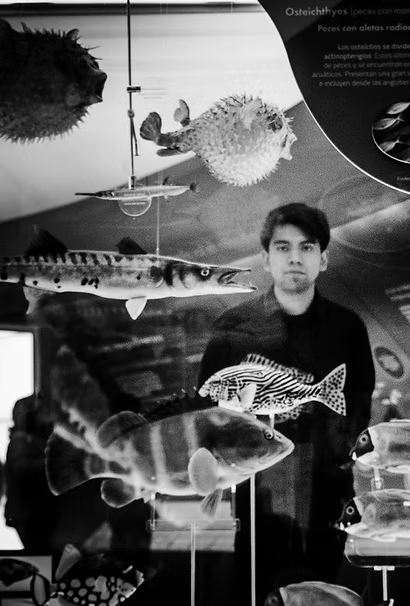
The work of Josué Mejía addresses the relationship between technological development and the political projects in which it is framed, analyzing - from a critical perspective - the processes that have given priority to certain production of technologies, generating precarious living conditions and asymmetrical social developments.
His current research focuses on the revision of technological updating projects within the Mexican territory - in its condition of processes ascribed to an economy of underdeveloped order -, directed towards a global dynamic, as well as in the use of certain processes cultivated in the counterculture, as the "do it yourself" or the technological appropriation within the hegemonic logics. The results of the developed process take shape in disciplines such as video, methodologies related to industrial design, among others.
The projects are conceived as proof of concept where the design, construction and implementation of devices - through an interdisciplinary character - allow the reflection on their operational possibility. These artifacts are the starting points for other narratives and fictions, where the latent failure in the possible insertion of said objects within the hegemonic structures allows us to observe their fissures and think about their unfortunate potential.
.avif)