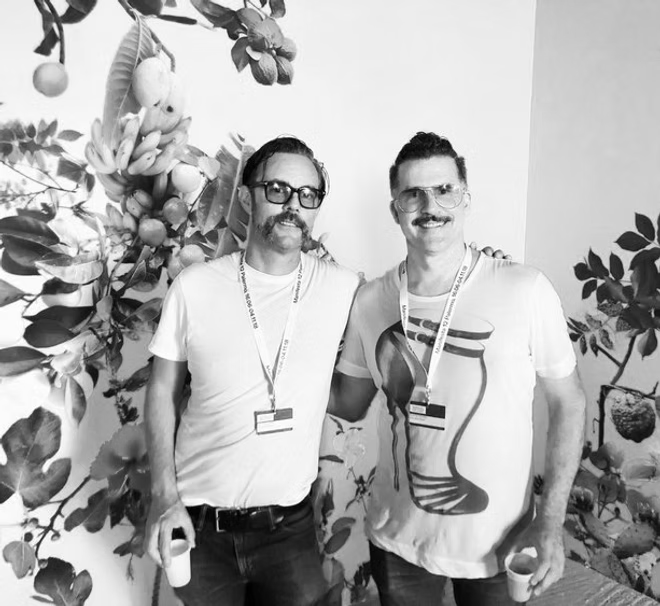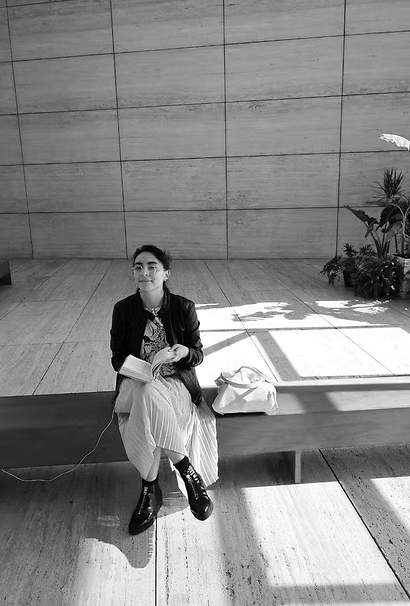
Unx (Colombian, b. 1986), Nabil Yanai (Mexican, b. 1991) & Liz Misterio all based in Mexico City.
INVASORIX is a collective currently consisting of Nina Hoechtl, Maj Britt Jensen, Liz Misterio, Una Pardo Ibarra, Naomi Rincón-Gallardo, Nabil Yanai and Adriana Soriano. Invasorix is interested in songs, music videos, publications, tarot readings and performative presentations as a form of queer-feminist protest. Through a continuous dialogue among themselves and with their imaginative friends, such as Gloria Anzaldúa, Pina Bausch, bell hooks, Pedro Lemebel, Silvia Rivera Cusicanqui, María Sabina, Patti Smith and Annie Sprinkle, they question gender roles and the intentions of artists, reflect on precarity and dream about alternative and/or utopian ways of living and being.
Their video “Macho intelectual” won the 1st prize in the category ACTIVISMO in the FEM TOUR TRUCK Festival Internacional de Videoarte Feminista. Other recent exhibitions include Sonic Futures at ICA San Jose, USA (2017), Women in Work. Mujer, Arte y Trabajo en la globalización at the Sala de Exposiciones de la Universidad Politécnica de Valencia, ES (2017), SOUND GENDER FEMINISM ACTIVISM SGFA 2016, London, UK (2016) and FEM TOUR TRUCK.
Festival Internacional de Videoarte Feminista in Spain, Portugal, Ecuador and Colombia (2016).
.avif)
For AKI AORA 2019 Invasorix were invited back to continue their research from last year’s residency in public space. For AKI AORA 2018 members of Invasorix (Unx and Nabil) explored, through body and dance, musical genres to "perrear" to. Having selected various reggaetón, dancehall, funky carioca, champeta, choke tracks whose lyrics uncharacteristically empowered women, they carried out different physical provocations as forms of queer feminist protest on the streets of Tulum. They used their bodies as a gesture to appropriate and reclaim public space, often positioning themselves near construction sites as a signifier to the incessant real estate construction that is part of the landscape of Tulum and that undermines the illusion, ‘eco-chic’ pretension of the place. These dances and music acted to deconstruct the exoticization and mythification of women and femininity defined on the basis of stereotypes of gender, sexuality and radicalization.
Over the past year, as an extension of this research they have been developing their own reggaeton song "My Güerx skin hurts horribly” to further probe how this musical genre can be implemented and understood as a ‘decolonial’ and feminist gesture. This led to the development of their new project for this year ‘Cop a feel on your V.I.P. position’ as they continued to explore public and private fluxes that site Tulum as a ‘caribbean paradise.’
For their first public intervention they set up a beauty studio in Tulum town’s streets - a deliberate alternative to the vernacular almost privatized beach-strip massage loungers aimed at servicing wealthy tourists. Instead they offered free facials exclusively to local Tulum residents. With their newly acquired, inconveniently long manicured nails, animal print pinnies and bright shorts as uniform they performed facial treatments which included ‘White Noise’ and ‘Give Back the Gold’ - the masks’ removal and accompanying salon conversations as symbolic cathartic acts to cleanse their clients of this ‘white noise’ probing the contradictions inherent in Tulum’s increasing take-over by the predominantly white privileged tourist.
Their project developed into working out how to rightfully and meaningfully acknowledge their own participation in this "white noise" as visiting artists, those culpable of coming to Tulum’s lands to intervene in the landscape, attempting to impose their own ways of being, living and thinking, in parallel to the tourist who arrives to the paradisiac place to consume, without caring about the social devastation and the environment that it leaves in its wake.
They developed several performative strategies to further investigate this position of privilege, firstly one in which they questioned their peers within the AKI AORA residency. Posing relevant and often uncomfortable questions to the other participants on the spot in front of a camera, questions that we as art practitioners are constantly considering; ‘What do you think of as privilege?’ as well as ‘How do you think art contributes to gentrification?’....
For their final performance, using a megaphone and dance they galvanized residents and tourists from the town’s most populated night-time area, calling any near-by observers to the space of performance, a wall near the street containing the town’s local reggaeton bar. They started their work with a bold performance of their reggaeton song who’s content reinforced and further probed questions of ‘white privilege’ and mocked and advised the guerra or ‘pale one’ on being more aware and demands that they face their ‘TASTY PRIVILEGES!’....WE TWERK THE WHITE SUPREMACIST CAPITALIST PATRIARCHY TO SMASH ITS COLONIALISM AND MONOPOLY.’
A video compilation of the interviews by residents and themselves on these notions then followed, focusing on the varying positions of the Mexican, US and British members of the residency, a ‘commercial break’ then ensued with a short advert containing the different facial masks they’d invented before culminating in a text-based intervention on the wall in Spanish and Mayan… a lasting public intervention for Spanish and Mayan speaking audiences along these themes of privilege.